
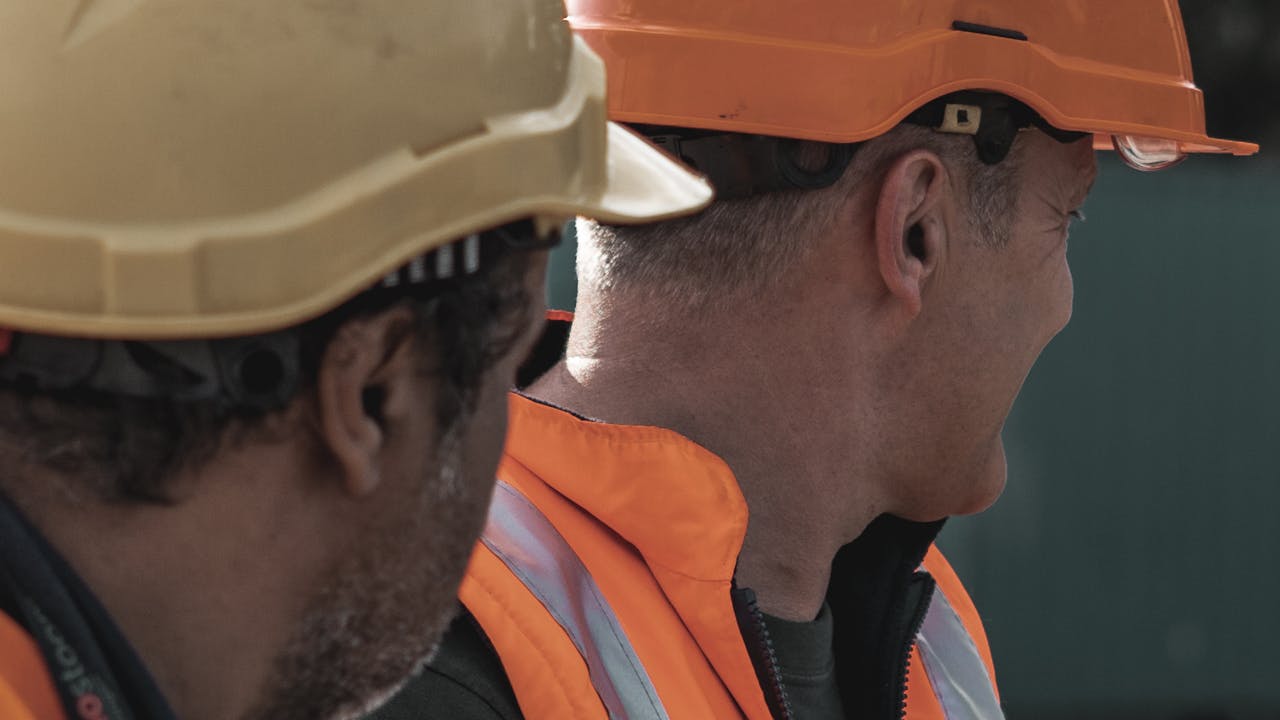
Personal protective equipment (PPE) is the last line of defense in workplace safety — the control you fall back on when a hazard can't be eliminated or engineered out. Because it's last in the hierarchy of controls, it's also the one most exposed to human factors: comfort, habit, availability and enforcement. This guide covers the main PPE categories, why compliance breaks down, and what actually moves the numbers.
The main types of PPE
- Head — hard hats and bump caps.
- Eye and face — safety glasses, goggles, face shields.
- Hearing — earplugs and earmuffs in high-noise areas.
- Respiratory — dust masks through to fit-tested respirators.
- Hand — cut-, chemical- and heat-resistant gloves.
- Foot — steel/composite toe, slip- and puncture-resistant soles.
- High-visibility clothing — vests and outerwear where vehicles or machinery operate.
- Fall protection — harnesses and lanyards for work at height.
Why compliance slips
PPE programs rarely fail because people don't know the rules. They fail at the margins:
- Comfort and fit — gear that's hot, heavy or ill-fitting gets removed.
- Availability — if the right size isn't to hand, the task happens anyway.
- The "quick task" trap — short jobs feel exempt; many injuries happen during them.
- Weak feedback loops — if non-compliance is never noticed, it becomes normal.
How to improve PPE compliance
- Get the gear right — comfortable, correctly sized, suited to the actual hazard.
- Train on the why — workers comply more when they understand the specific risk.
- Make leadership visible — supervisors who wear PPE everywhere set the norm.
- Close the feedback loop — timely, consistent reminders beat occasional crackdowns.
- Measure it — you can't improve a compliance rate you don't track.
An enforcement rule nobody checks is a suggestion. Consistent, timely feedback is what turns PPE policy into PPE behavior.
Where monitoring fits
Tracking PPE compliance manually doesn't scale — no one can watch every person on every camera all shift. This is where automated visual monitoring helps, and where it's worth being precise about its limits. Computer vision is reliable for large, high-contrast items worn in a predictable place — hard hats and hi-vis vests especially — and can continuously check zones where that gear is required. It's far weaker on items whose correct use matters more than mere presence (a respirator's seal, a harness's anchor). The practical pattern is to automate the visible, scalable checks and keep a human in the loop for judgment calls.
The takeaway
PPE is essential precisely because it's the last defense — so the goal is consistency, not occasional blitzes. Right gear, real training, visible leadership and a fast feedback loop do most of the work; monitoring extends that loop to every camera, every shift, for the PPE that's actually detectable.
All posts