
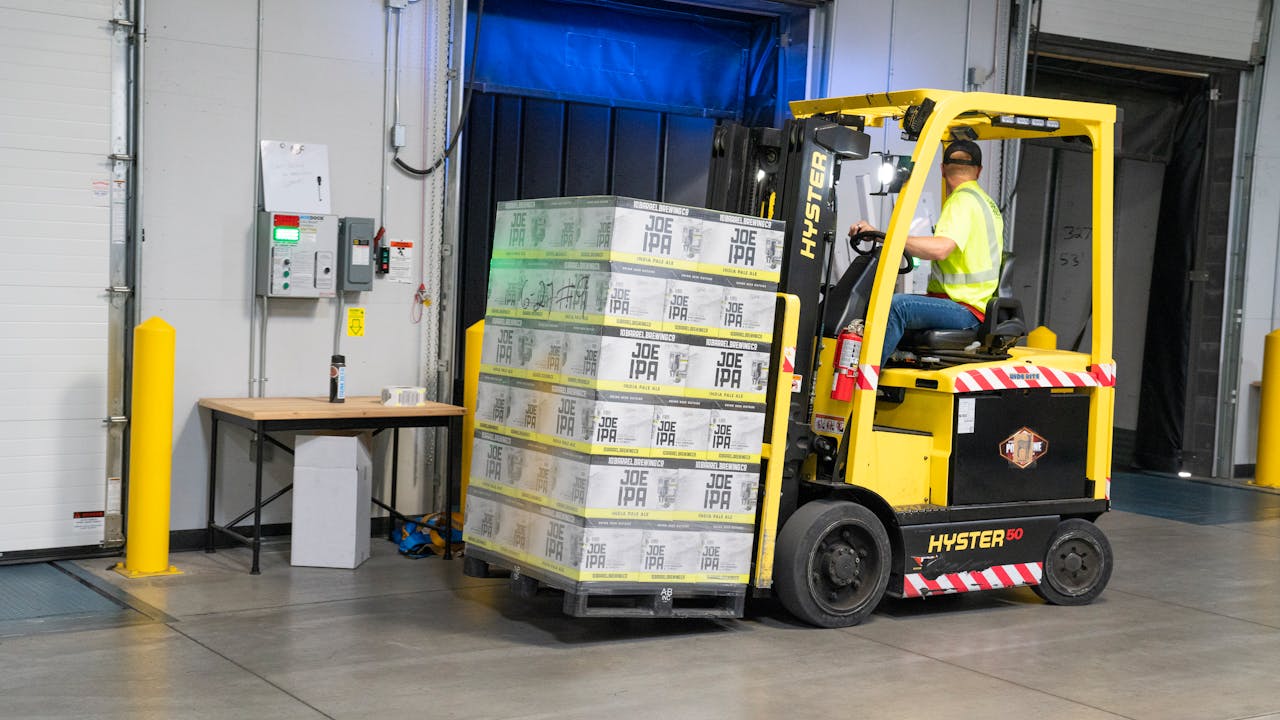
Forklifts — powered industrial trucks — are among the most common causes of serious injury in warehouses and yards. They're heavy, they accelerate quickly, they have significant blind spots, and they routinely share space with people on foot. When a collision happens, the pedestrian almost always comes off worse. This guide covers why forklift–pedestrian incidents occur and the proven strategies for preventing them.
Why forklift–pedestrian collisions happen
- Shared space — people and trucks using the same aisles and routes.
- Blind spots and loads — a raised or bulky load can block the operator's view entirely.
- Blind corners and intersections — limited sightlines where routes cross.
- Speed — even modest speeds leave little time to react in tight spaces.
- Complacency — familiarity in a busy environment dulls awareness over time.
Separation strategies, strongest first
As with any hazard, the most effective controls remove the interaction rather than relying on care in the moment:
- Eliminate the overlap — separate delivery and pedestrian times, or redesign flow so people and trucks don't mix.
- Physical segregation — barriers and clearly marked, protected walkways.
- Controlled crossings — designated, well-signed crossing points with right-of-way rules.
- Visibility aids — mirrors at blind corners, proximity warnings, good lighting.
- Signage, training and hi-vis — the administrative and PPE layer that backs up the rest.
The near-miss iceberg
Safety has long recognized that every serious injury sits on top of a much larger base of minor incidents and near-misses. With forklifts, that base is mostly invisible: a pedestrian who steps clear of a reversing truck rarely files a report. Yet those unrecorded near-misses are the richest early-warning data a site has — they reveal the blind corner or the shortcut that will eventually cause an injury.
The near-miss nobody logged this month is the incident report you write next quarter.
Where monitoring fits
Capturing near-misses manually is unrealistic — they happen in a second and no one is hurt. Increasingly, camera-based monitoring is used to log them automatically: zone and proximity detection can flag when a pedestrian enters an active vehicle lane, or when a person and a truck come within a set distance, and aggregate those events to surface hotspots. The value is twofold — a real-time prompt in the moment, and a heat-map of where to add a barrier, mirror or route change.
The takeaway
Forklift safety is fundamentally about separating people from moving trucks, and backing that separation with visibility and data. Start with the highest-traffic choke points — docks, aisle intersections, blind corners — design out the overlap where you can, and find a way to capture the near-misses you're currently missing.
All posts