
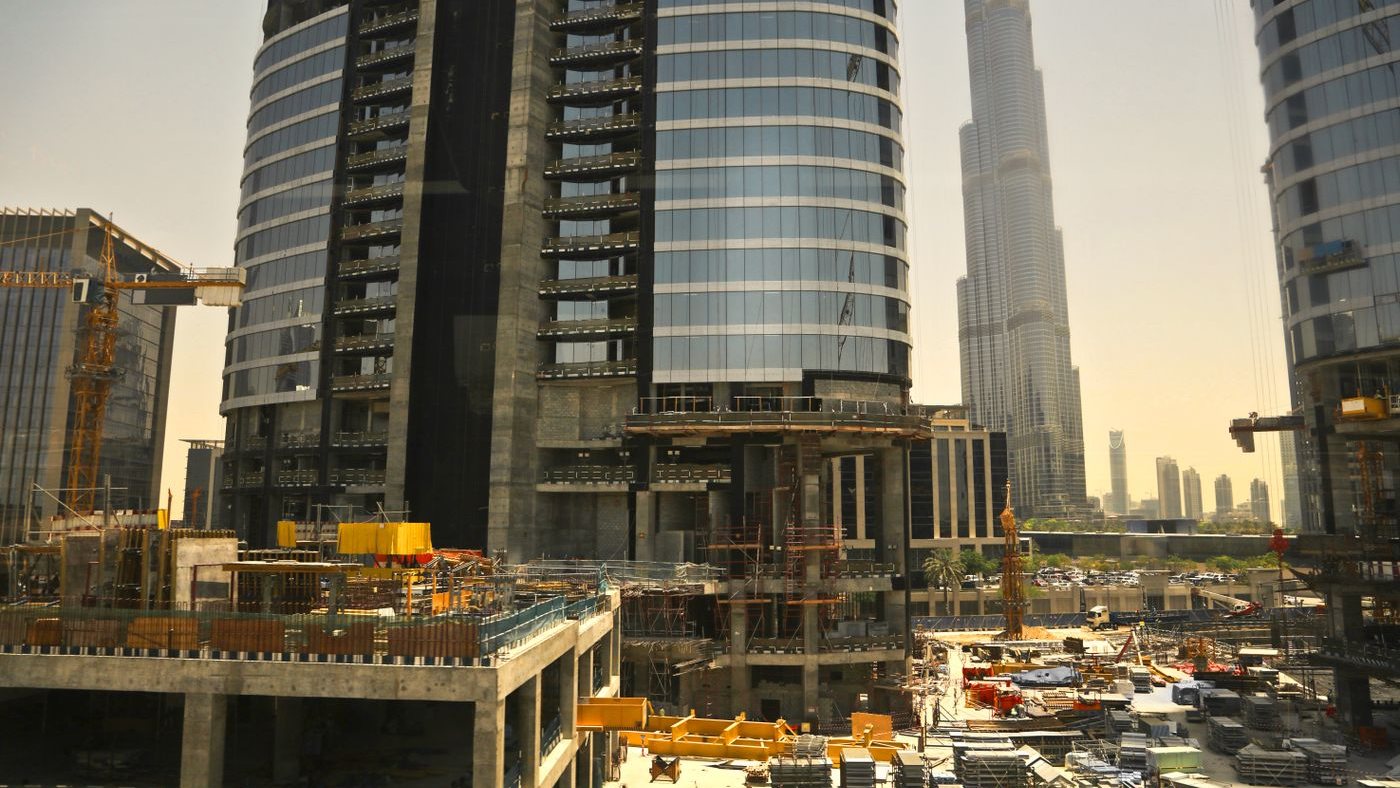
AED 200,000 is the number in every headline about Dubai Law No. 7 of 2025. It is also, strictly speaking, the wrong number.
Here is the actual mechanic. A violation carries a fine of AED 1,000 to AED 100,000 — rising to AED 200,000 for repeat violations, which the published analyses describe as a doubling where the same violation recurs within one year (Clyde & Co; Beale & Co). So the famous figure isn't a fine. It's a receipt for not fixing something the first time.
And the money is the least interesting part.
The part that actually hurts
Alongside fines, the enforcement toolkit runs to suspension of contracting activity, reclassification, deregistration and cancellation of professional certificates (Clyde & Co). Suspension is reported as being for up to one year, and deregistration as requiring committee approval (Al-Shamsi Legal); revocation of commercial licences is also reported among the available sanctions (Beale & Co).
A fine is a line item. A classification downgrade is a change to which projects you are allowed to bid on at all.
What Law No. 7 changed, in sixty seconds
- Issued 8 July 2025, in force 8 January 2026 (Clyde & Co).
- Existing contractors get one year from the effective date to regularise their status — so 8 January 2027 — and the committee may extend that period (Al-Shamsi Legal).
- One register. Dubai Municipality establishes and manages a unified contractor registry — covering licensed activities, classification and technical staff — on a unified electronic system linked to the Invest in Dubai platform (Al-Shamsi Legal).
- Classification works to standards tailored to each contractor's financial, technical and administrative capacities and experience (Al-Shamsi Legal).
- Stay in your lane. Contractors must abide by the scope of their licensed activities and assigned classification tier, and must not undertake projects exceeding their financial, technical or manpower capabilities (Al-Shamsi Legal).
- Subcontracting only with prior approval from Dubai Municipality, and all participating contractors must be properly licensed and registered (Clyde & Co; Al-Shamsi Legal).
- Named people, certified. Dubai Municipality issues professional competency certificates to technical personnel (Al-Shamsi Legal).
- Ten-year records. Contractors must retain original copies of contracting agreements, plans and records for at least ten years from project completion or contract expiry (Clyde & Co).
- Scope. It reaches contractors in special development zones and free zones, including the DIFC — while airport-related contracting activities are excluded, and further activities may be excluded by decision of the Chairman of the Executive Council (Al-Shamsi Legal; Clyde & Co).
Among the compliance obligations are laws relating to construction, planning, environment, health and safety (Al-Shamsi Legal).
The safety layer most summaries skip
The operational safety detail doesn't sit in Law No. 7 at all. It sits in the Code of Construction Safety Practice, which Decree No. 19 of 2025 — issued 7 April 2025 and effective three months after publication in the Official Gazette — made binding. Article 4 requires that "all Contractors and engineering consultancy firms must comply with all the safety rules, standards, guidelines, and obligations set out in the Safety Code," and Article 5 gives the Code "the same binding force as the Legislation published in the Official Gazette." The Decree applies across Dubai including special development zones and free zones such as the DIFC, and under Article 7 the Chairman of the Executive Council issues a resolution specifying what constitutes a violation and the corresponding administrative penalties (Dubai Legislation Portal).
Read the two together and the picture is simple. The Code sets the safety rules for the site. Law No. 7 governs who is allowed to hold the contract in the first place — and prices the consequences of falling short.
What's on the table
| Measure | What it is | Why operators care |
|---|---|---|
| Fine | AED 1,000 – 100,000 | Rises to AED 200,000 for repeat violations within a year |
| Suspension | Contracting activity halted, reported as up to one year | Mobilised crews and live programmes don't pause with you |
| Reclassification | Classification tier downgraded | Shrinks the size of work you're permitted to take |
| Deregistration | Removal from the registry, on committee approval | No register entry, no contracting in Dubai |
| Licence action | Revocation of the commercial licence | A company-level outcome, not a project-level one |
| Certificate cancellation | Professional competency certificates cancelled | Your named technical staff lose their standing, and you lose them |
Sources for the table: Clyde & Co, Al-Shamsi Legal, Beale & Co.
The twelve-month window changes how you treat a lapse
The escalation to AED 200,000 turns on a repeat within a year. That makes close-out a dated, evidenced activity rather than paperwork theatre — because the thing that keeps the multiplier off is being able to show the first finding was actually resolved, months later, to someone who wasn't there.
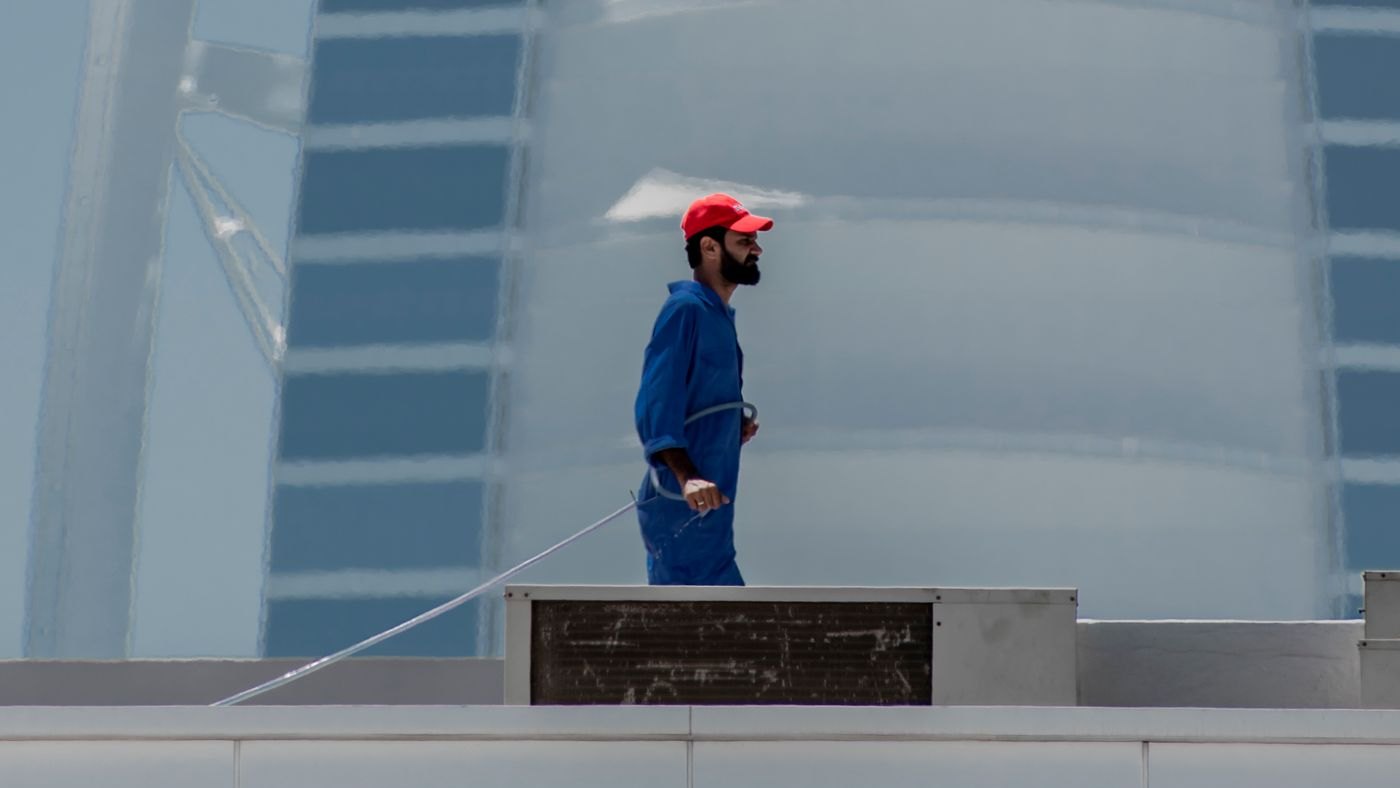
Rooftop work near an edge — the kind of routine, twenty-minute task that generates far more inspection findings than its share of the programme would suggest.
What we look for in the first ninety seconds
Not a statutory checklist — the Code is the authority on requirements. This is simply what tends to be visible from the gate, in our experience across sites:
- Edges and openings. Guardrails, covers, anchor points — and whether harnesses are clipped or just worn.
- Scaffolding. Tagged and complete, or quietly modified overnight by whoever needed the gap.
- PPE in use, not in stores. Issued isn't worn, and only one of those is visible from the gate.
- Hot works and fire. Permits, extinguisher coverage, escape routes that aren't stacked with material.
- Housekeeping. The cheapest signal of how a site is run, and the first thing anyone reads.
- Paperwork that matches reality. Is the person supervising the person named on the file?
Inspectors don't audit your intentions. They audit the fifteen minutes they happen to be standing in front of.
The ten-year records problem
Retaining a method statement for a decade is easy — and, per the retention obligation above, now required for agreements, plans and records. Proving what a site actually looked like at 14:40 on a Tuesday is the harder half. Registers and toolbox-talk sheets record what you intended. Incident files record what went wrong. The gap in between — the near miss, the two hours the edge protection was down, the corrective action you genuinely did complete — is exactly the material a repeat-violation argument turns on, and it is usually the least documented part of the operation.
Where continuous monitoring fits — and where it doesn't
Cameras don't make a site compliant. Engineering controls, competent supervision and a permit system do. What computer vision on your existing CCTV adds is timing and evidence: it can flag missing PPE, a person at an unprotected edge, or someone inside an exclusion zone while the shift is still running, and it leaves a timestamped record you can keep for as long as retention requires.
It won't erect a guardrail, test an atmosphere or argue with an inspector. What it does is shorten the distance between a lapse and someone noticing — which, under a regime that raises the price of the same mistake the second time, is worth real money as well as the obvious.
Six things worth doing before 8 January 2027
- Confirm your registry entry and classification tier — then check what you're bidding actually fits inside it.
- Verify every named technical person holds a current professional competency certificate.
- Get subcontracting approval from Dubai Municipality before mobilisation, and confirm every participating contractor is licensed and registered.
- Read the Code of Construction Safety Practice against what your sites look like today, not what the manual says they look like.
- Fix retention properly: ten years from completion or expiry, retrievable — not a hard drive in a portacabin.
- Close out every finding with dated evidence. That file is your defence against the escalation.
The takeaway
Law No. 7 didn't invent new hazards. Falls, scaffolds, fire and struck-by incidents were on Dubai sites long before July 2025. What changed is the transmission between a site condition and a commercial consequence: it got shorter, it got written down, and the escalation now has a twelve-month memory. Operators who treat the grace period as breathing room will spend 2027 explaining themselves. The ones who use it to make site conditions visible — continuously, not on inspection day — will mostly never meet the AED 200,000 number at all.
Sources
- Decree No. (19) of 2025 Concerning Safety in Construction Works in the Emirate of Dubai — Dubai Legislation Portal (official text). dlp.dubai.gov.ae
- "Dubai's New Contracting Law: Changes are Coming" — Clyde & Co, July 2025. clydeco.com
- "Law No. 7 of 2025 on the Regulation of Contracting Activities in the Emirate of Dubai" — Ibrahim Mohamed, Al-Shamsi Legal (HAS Law), 15 July 2025. has.law
- "Dubai's Law No. 7 of 2025: Transforming the Contracting Sector in the Emirate" — Beale & Co. beale-law.com
A note on dates: the sources are not unanimous. Clyde & Co give publication as 8 July 2025 and entry into force as 8 January 2026, which is the majority position and the one used above; Al-Shamsi Legal state 15 July 2025 and 15 January 2026 (in an article itself posted on 15 July). We could not locate an official English text of Law No. (7) of 2025 on the Dubai Legislation Portal to settle the point, so the grace-period date above should be treated as approximate. Decree No. (19) of 2025 is quoted from the official text; all Law No. 7 provisions are attributed to published legal analyses rather than the gazette.
General information, not legal advice. Verify specifics against the official texts and the current edition of the Code of Construction Safety Practice, and take qualified advice on your own obligations.
All posts