
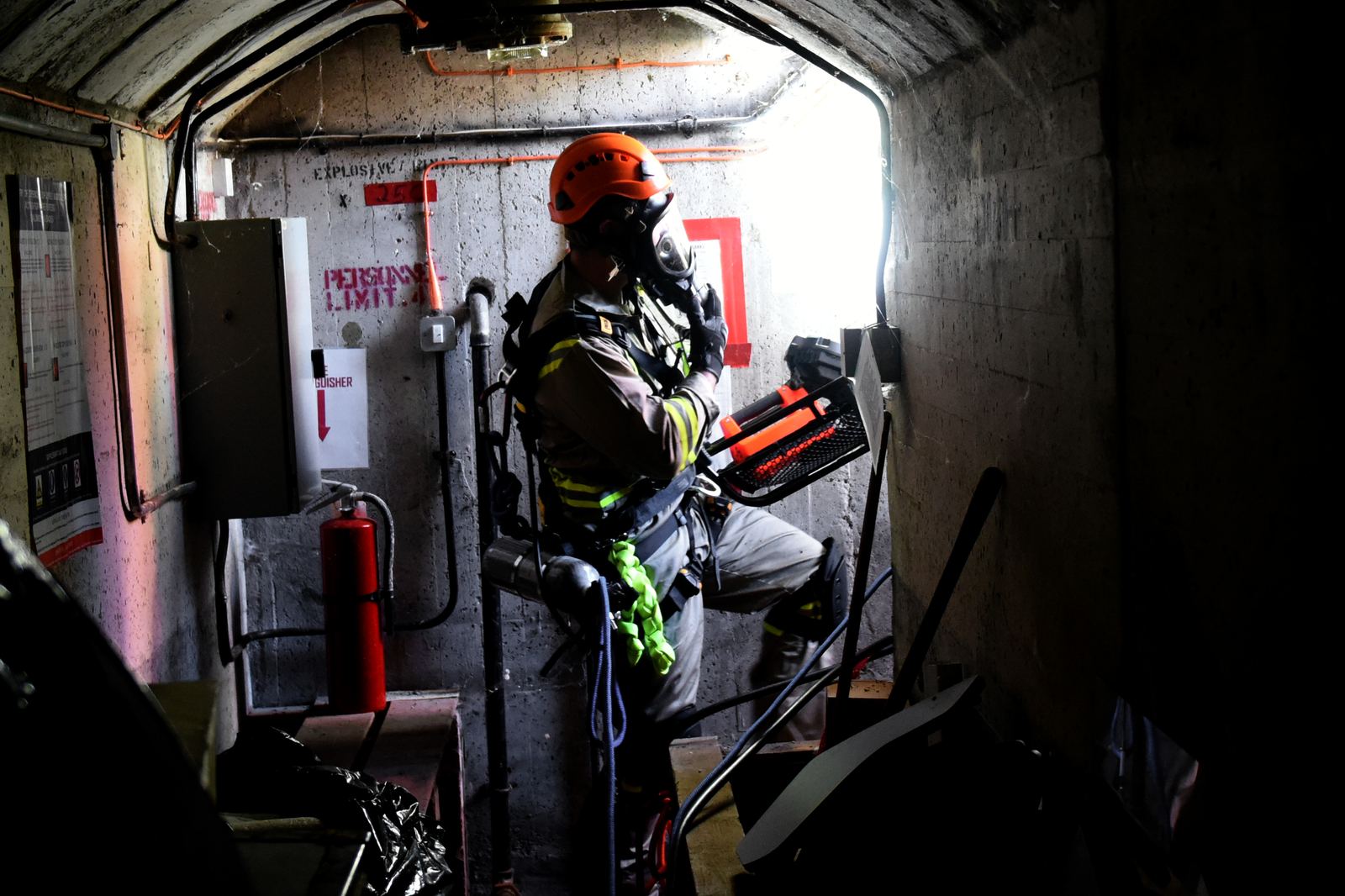
Confined spaces are responsible for a disproportionate share of workplace fatalities relative to how rarely people enter them. Tanks, silos, sewers, manholes, pits, vaults, boilers and pipelines share a dangerous combination: they are hard to get into, hard to get out of, and often contain an atmosphere that can kill in minutes with no warning. The most sobering statistic is that a large fraction of confined-space deaths are would-be rescuers — coworkers who rushed in to help and were overcome by the same hazard.
This guide covers what makes a space "confined," the hazards that make entry so dangerous, how the permit system controls those hazards, and why a rescue plan is not optional.
What counts as a confined space
A confined space is generally defined by three characteristics together:
- Large enough to enter and perform work.
- Limited or restricted means of entry and exit — a narrow hatch, a top-only opening, a ladder down a shaft.
- Not designed for continuous occupancy — nobody is meant to work there all day.
When such a space also contains — or could contain — a serious hazard, it becomes a permit-required confined space: entry is only allowed under a formal, documented permit system. That covers hazardous atmospheres, engulfment risk, an internal shape that could trap or asphyxiate an entrant, or any other recognized serious hazard.
Why confined spaces are so dangerous
The hazards fall into a few categories, and more than one is often present at once:
- Oxygen deficiency or enrichment — rust, decomposition, or displacement by another gas can quietly lower oxygen below safe levels. Too much oxygen, meanwhile, makes everything more flammable.
- Toxic atmospheres — hydrogen sulfide (H₂S) in sewers and tanks, carbon monoxide from engines, or residues from whatever the vessel last held. Many of these are odorless or deaden the sense of smell at dangerous concentrations.
- Flammable atmospheres — vapors or gases that can ignite from a single spark or hot tool.
- Engulfment — grain, sand, water or other flowable material that can bury and suffocate a worker.
- Physical and mechanical hazards — moving parts, agitators, live electrical circuits, extreme heat, or a converging shape that traps.
The defining danger of a confined space is that it gives no second chance: an atmosphere that reads normal at the hatch can be lethal a few feet down, and a collapsed worker can't self-rescue.
The entry permit system
A permit-required entry is controlled by a written permit that must be completed before anyone goes in. A good permit forces the team to confirm, in order:
- Isolation and lockout — the space is disconnected from incoming lines, and any moving equipment inside is locked out and tagged out.
- Atmospheric testing — the air is tested from outside, top to bottom, for oxygen, flammable gases, and toxics, in that order, before entry and continuously during it.
- Ventilation — mechanical ventilation clears and keeps clearing the space; a space is never "aired out" and forgotten.
- Roles assigned — a trained entrant, an attendant, and an entry supervisor are named.
- Rescue arranged — a rescue plan and the means to execute it are confirmed on site before entry begins.
The permit is time-bound and is cancelled when the work is done or when conditions change. If anything on the permit stops being true — the ventilation fails, a monitor alarms, an unexpected hazard appears — the entry stops and everyone comes out.
The three roles
- Entrant — the person inside, trained to recognize hazard symptoms and to exit immediately on an alarm or an order to evacuate.
- Attendant — stationed outside, in constant contact with the entrant, monitoring conditions and controlling who approaches. Critically, the attendant never enters to attempt a rescue — doing so is how one casualty becomes two.
- Entry supervisor — authorizes the permit, verifies that every control is in place, and terminates entry when required.
Rescue: planned, not improvised
The instinct to jump in after a collapsed coworker is exactly what makes confined spaces so deadly. Effective programs plan for non-entry rescue wherever possible — a retrieval line and harness connected to a tripod and winch at the opening, so an unconscious entrant can be pulled out from outside. Where entry rescue is unavoidable, it is performed only by trained, properly equipped rescuers with their own breathing apparatus. A rescue capability that is "we'll call the fire brigade" without confirming their response time and confined-space capability is not a plan.
Where continuous monitoring fits
Gas detectors, ventilation and a disciplined permit process remain the core of confined-space safety — nothing replaces them. Where continuous visual monitoring helps is at the boundary: computer-vision systems watching existing camera feeds can flag entry into a marked confined space or exclusion zone without an active permit or an attendant present, or a person approaching an open manhole or hatch. It doesn't test the air and it doesn't perform the rescue — but it shortens the time between an unauthorized or unattended entry and someone noticing, which in a confined space is the difference that matters.
The takeaway
Confined spaces punish improvisation. Treat every permit-required entry as the hazard it is: isolate and lock out, test and ventilate the atmosphere, assign trained roles, and confirm a workable rescue plan before the first person goes in. Confirm the specific requirements for your region and industry — but the principle is universal. The goal is simple to state and hard to hold to under time pressure: nobody enters until the space is proven safe, and nobody follows a downed worker in without protection.
All posts