
Every year, close to 3 million people die from work-related accidents and diseases worldwide, according to the International Labour Organization, and hundreds of millions more are injured. Behind almost every one of those numbers is the same uncomfortable truth: someone saw the warning signs — a blocked exit, a missing harness, a forklift cutting a corner — and the information arrived too late, or never arrived at all.
That is the gap artificial intelligence is closing. Not by replacing safety professionals, but by giving them something they have never had: eyes that never blink, and data that looks forward instead of back. The shift is already measurable — organizations deploying AI-driven safety monitoring routinely report double-digit reductions in recordable incidents — and scaled across industry, that translates into thousands of lives.
From reactive to preventive
Traditional safety management is largely retrospective. Incidents are logged, investigated, and corrective actions are issued — after someone has already been hurt. Audits and inspections help, but they sample a site a few hours a month, while hazards exist every minute of every shift.
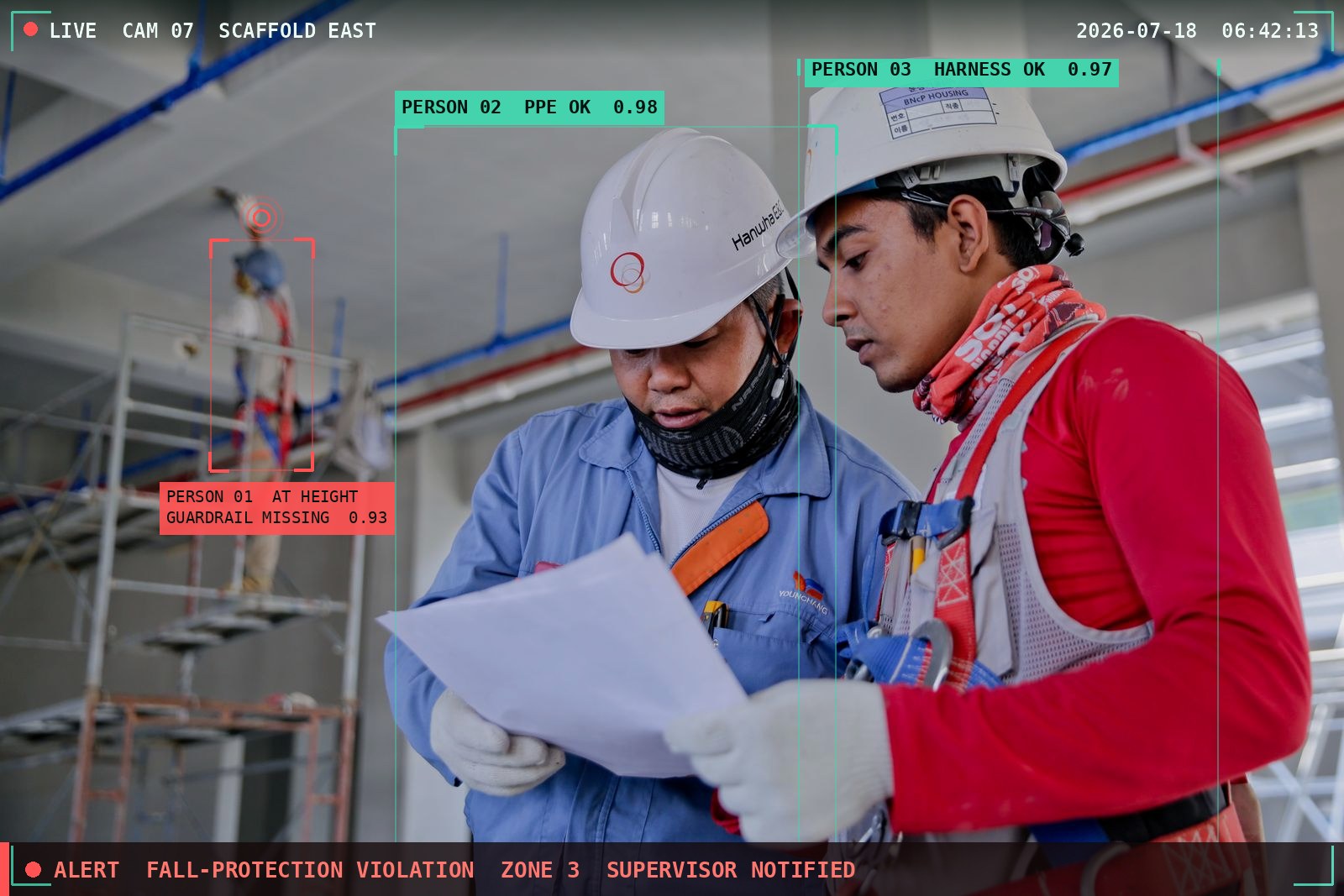
AI inverts the model. A computer-vision system connected to existing CCTV watches every camera, on every shift, and reacts in seconds:
- PPE compliance — a worker enters a mandatory-helmet area without one, and a supervisor is alerted before the task begins, not after the head injury.
- Restricted zones — a person steps inside a crane's swing radius or an energized enclosure, and the alert fires the moment the line is crossed.
- Vehicle–pedestrian conflicts — forklifts and people converging in the same aisle are flagged as near-misses, the precursor events that classically precede a serious collision.
- Falls and unsafe postures — a person down on the floor of a remote area is detected in seconds, when minutes decide the outcome.
- Fire and smoke — visible smoke is caught by camera analytics before conventional detectors trip, buying the response time that keeps an ignition from becoming a catastrophe.
Each alert on its own is small: one hard hat, one zone breach, one near-miss. But safety science has known since Heinrich's era that serious injuries sit on top of a pyramid of hundreds of minor deviations. Catch the deviations continuously, and you dismantle the pyramid before it produces a fatality.
The most important accident in workplace safety is the one that never happens — and never shows up in any statistic.
Predictive analytics: seeing the accident before it happens
Real-time detection is only half the transformation. The other half is what happens to all of that data afterwards.
Every detection — time, place, camera, hazard type — becomes a data point. Over weeks, those points form patterns no human log book could reveal:
- PPE violations spike in the last hour of the night shift, when fatigue peaks.
- One loading dock generates five times the near-misses of any other — always when two delivery windows overlap.
- Zone breaches cluster around a single contractor crew that never received site induction.
- Housekeeping deviations climb steadily in the week before every previous recordable injury.
This is predictive safety analytics: using leading indicators — near-misses, unsafe conditions, behavioral deviations — to forecast where the next incident is most likely, and intervening there first. Instead of asking "what went wrong last quarter?", safety teams can ask "which shift, which zone, and which task is trending toward an incident right now?"
The interventions it enables are practical, not exotic: reschedule the overlapping delivery windows, add a barrier at the one bad dock, re-brief the crew that keeps breaching the zone, rotate tasks before the fatigue window. Small, targeted fixes — aimed by data at exactly the place the next injury was going to happen.
Why this saves lives at scale
Three properties make AI monitoring different in kind, not just degree, from what came before:
- Coverage — it watches 100% of camera-visible time, not the <1% an inspection samples. Lapses are noticed in seconds instead of persisting for hours.
- Consistency — it applies the same standard at 3 a.m. on a Sunday as at 10 a.m. on audit day. Risk normalization — the slow drift of "we always do it this way" — becomes visible.
- Memory — every event is recorded and comparable, so improvement is measurable and the precursors of the next incident are searchable in advance.
Multiply those properties across the workplaces already using this technology — construction sites, warehouses, factories, ports — and the arithmetic is straightforward. If continuous monitoring and predictive intervention prevent even a modest fraction of the incidents behind the ILO's numbers, the result is thousands of workers going home each year who otherwise would not have.
What AI does not replace
None of this removes the human core of safety. AI does not design a fall-protection plan, choose the right controls, or build a culture where workers stop a job that feels wrong. Guardrails still beat alerts; elimination still beats detection. What AI removes is the blindness — the gap between a control slipping and someone noticing. Safety professionals stop being auditors of the past and become managers of live risk.
Privacy matters here too. Done right, monitoring targets hazards, not people: alerts describe unsafe conditions, footage stays on-premise under the operator's control, and data is used to fix systems rather than to discipline individuals. That framing is not just ethical — it is what makes workers trust and support the system that protects them.
The takeaway
Workplace safety is undergoing its biggest shift since the hard hat: from documenting accidents to preventing them. Real-time computer vision closes the seconds-long gap where injuries happen; predictive analytics closes the weeks-long gap where risk quietly builds. Together they turn the safety pyramid into an early-warning system — and every near-miss caught at the bottom is a life protected at the top.
All posts